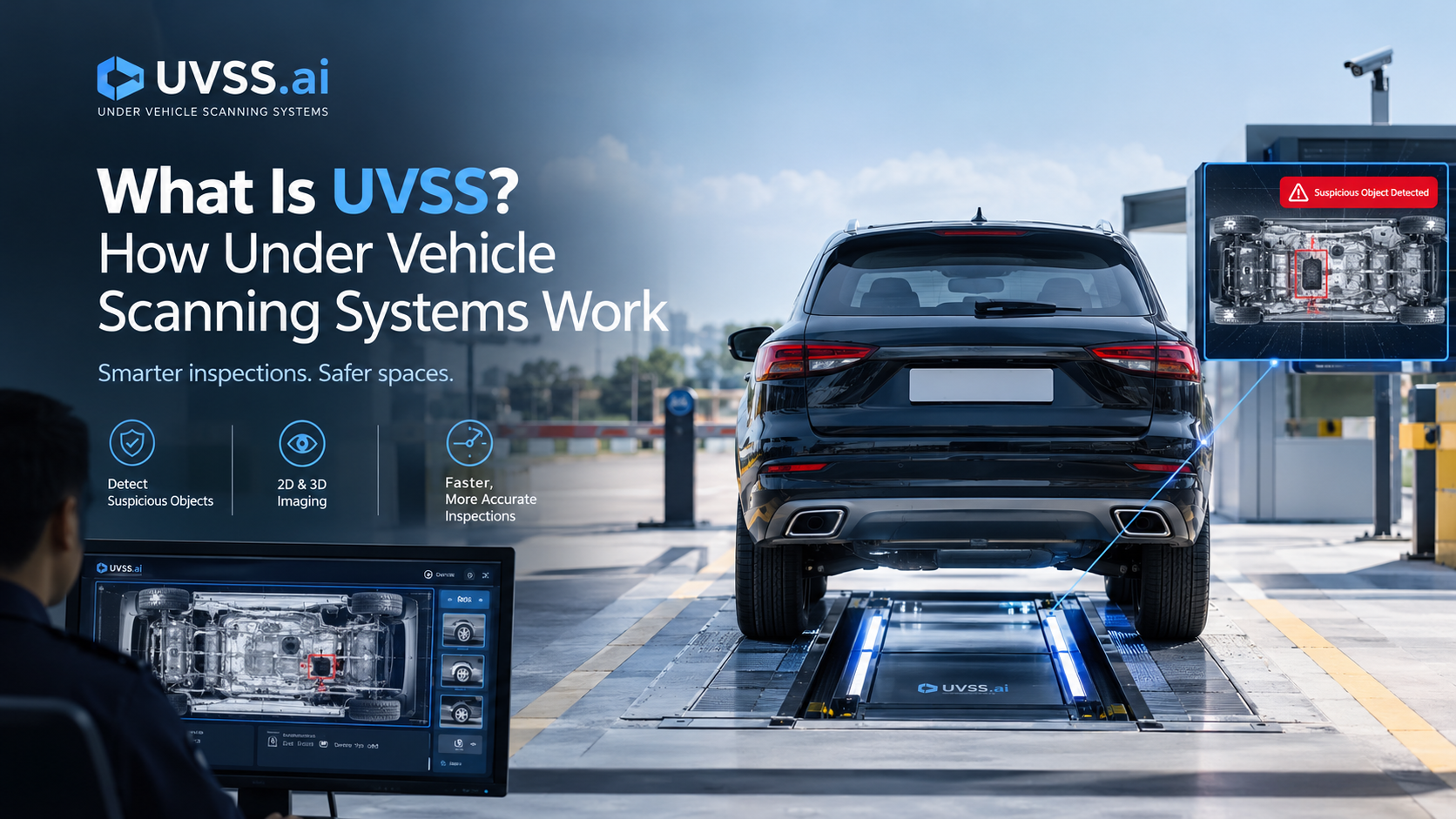
What Is UVSS? How Under Vehicle Scanning Systems Work
Vehicle security is a critical consideration at airports, seaports, government buildings, industrial facilities and other restricted-access locations. Inspecting the underside of every vehicle manually can take time and may leave security personnel with limited visibility. An under vehicle scanning system (UVSS) provides a faster, image-based way to examine a vehicle’s undercarriage before it enters a protected area.
But what is UVSS, how does the technology work, and how can organisations choose the right system? This guide explains the fundamentals of modern under vehicle scanning systems and their role in vehicle security.
What Is UVSS?
UVSS stands for Under Vehicle Surveillance System. It is a security technology designed to capture images of a vehicle’s underside so operators can inspect areas that are difficult to see during a conventional vehicle check.
A typical UVSS uses specialised cameras, illumination, sensors and image-processing software to capture the undercarriage as a vehicle passes through an inspection lane. Depending on the configuration, the system can produce detailed 2D images or 3D visualisations for further examination.
Modern systems may also include image comparison, anomaly detection, vehicle identification and integration with access control or surveillance infrastructure.
The purpose is to help security teams identify suspicious objects, unexpected attachments, possible tampering or changes to a vehicle’s underside. UVSS supports the inspection process; it does not replace professional judgement or guarantee the detection of every threat.
What Is an Under Vehicle Scanning System (UVSS)?
An under vehicle scanning system is the equipment and software used to inspect the underside of cars, vans, buses, trucks and other vehicles at controlled entry points.
The system generally consists of several components:
- Imaging cameras: Capture detailed views of the vehicle’s undercarriage.
- Illumination units: Provide suitable lighting for consistent image capture.
- Vehicle detection sensors: Trigger or coordinate scanning when a vehicle enters the inspection area.
- Image-processing software: Creates a usable undercarriage image or 3D representation.
- Operator interface: Allows security personnel to review images, examine suspicious areas and access inspection records.
- Integration options: Depending on the model, connect the scanner with CCTV, number plate recognition, vehicle databases or access control systems.
Some installations use a scanner embedded into the roadway, while others use surface-mounted equipment or portable configurations. The appropriate option depends on traffic volume, site layout, installation constraints and security requirements.
How Does UVSS Improve Vehicle Security?
The underside of a vehicle can contain areas that are difficult to inspect safely and consistently with a mirror or handheld torch. A UVSS provides a recorded visual representation of these areas, helping operators carry out inspections more systematically.
For high-security sites, the system can support faster vehicle screening, repeatable inspection procedures and a documented record of vehicle checks. When configured for image comparison, it may also help identify changes between a previously recorded undercarriage and a new scan.
How Does a UVSS System Work?
Understanding how to operate a UVSS system starts with the inspection process. Although the exact workflow varies by model, a typical automated installation follows these steps.
1. Vehicle Detection
As a vehicle approaches or enters the inspection lane, sensors or the configured trigger mechanism detect its presence. The system prepares to capture the undercarriage image.
2. Undercarriage Image Capture
Specialised cameras photograph the underside as the vehicle passes over or through the scanning area. Appropriate illumination helps reveal details around the chassis, axles, wheels and other visible components.
3. Image Processing and Reconstruction
The system processes the captured images to create a continuous undercarriage view. Depending on the technology, this may involve combining multiple image frames into a composite image or generating a 3D representation.
4. Image Review and Anomaly Detection
Security personnel examine the resulting image for unfamiliar attachments, concealed objects, signs of tampering or other irregularities. Systems with suitable software may compare new scans against reference images or flag potential anomalies automatically.
An alert should be treated as an indication for further investigation, not automatic proof of a threat.
5. Verification and Entry Decision
If the scan reveals a suspicious area, authorised personnel can conduct additional checks according to the site’s security procedures. The vehicle is cleared, referred for further inspection or denied entry based on the applicable policy.
6. Record Keeping
Where supported, the system stores scan images, timestamps, vehicle information and inspection outcomes. These records can help with audits, investigations and the review of recurring security concerns.
2D vs 3D Under Vehicle Scanning Systems: What Is the Difference?
Choosing between 2D and 3D imaging is an important consideration when selecting an under vehicle scanner.
2D UVSS: Produces detailed two-dimensional images of the vehicle’s underside. It can provide a clear visual record for routine screening and help operators identify visible anomalies. Depending on the model, 2D systems may use different camera and image-reconstruction technologies.
3D UVSS: Adds depth information or three-dimensional visualisation to support a more detailed examination of the undercarriage. Depending on the technology, this can help operators distinguish physical objects from certain shadows, surface marks or variations in shape.
For example, UVSS.ai offers the NuvoScan P and NuvoScan E for 2D imaging, alongside NuvoScan 3D and DepScan 3D for 3D inspection applications.
The best option depends on the required image detail, inspection environment, traffic throughput, integration requirements and the types of anomalies the security team needs to investigate.
Where Are Under Vehicle Scanning Systems Used?
UVSS technology can support vehicle screening across a range of environments, including:
- Airports and seaports: Screening vehicles entering controlled operational areas.
- Government and defence facilities: Supporting security checks at restricted entrances.
- Industrial sites: Inspecting vehicles accessing sensitive manufacturing or operational areas.
- Logistics and distribution centres: Helping screen delivery vehicles and transport fleets.
- Corporate campuses and critical infrastructure: Adding an undercarriage inspection layer to existing access control procedures.
Actual suitability depends on the site’s risk assessment, installation conditions and operational requirements.
How to Choose the Right Under Vehicle Scanning System
Before investing in a UVSS, consider the following factors:
- Imaging technology: Decide whether 2D imaging is sufficient or whether 3D visualisation would provide useful additional detail.
- Traffic requirements: Assess the number and types of vehicles passing through the checkpoint and the required inspection speed.
- Installation type: Compare embedded, surface-mounted and portable configurations against available space and site infrastructure.
- Software and integration: Check compatibility with existing CCTV, automatic number plate recognition (ANPR), access control and reporting systems.
- Environmental conditions: Review the equipment’s specified operating conditions, enclosure protection and maintenance needs.
- Operator training and support: Ensure personnel can interpret scans, investigate alerts and follow consistent inspection procedures.
A well-matched UVSS should support the complete security workflow, from image capture to verification and record keeping, rather than simply producing an image.
Frequently Asked Questions About UVSS
What does UVSS stand for?
UVSS stands for Under Vehicle Surveillance System. It is used to capture and examine images of a vehicle’s underside for security inspection.
What is the main purpose of an under vehicle scanning system?
Its main purpose is to help security personnel inspect vehicle undercarriages, identify suspicious objects or changes, and support vehicle screening at controlled entry points.
How does an under vehicle scanner work?
A typical scanner uses cameras, illumination and sensors to capture undercarriage images. Software processes the images for operator review and may flag potential anomalies, depending on the system’s capabilities.
Is a 3D UVSS better than a 2D system?
Not in every situation. A 3D system can provide additional depth information, while a 2D system may be suitable for many routine visual inspection requirements. The right choice depends on the site’s security risks, budget and operational needs.
Can a UVSS detect every concealed threat?
No. Detection depends on the equipment, image quality, vehicle conditions, software capabilities and inspection procedures. UVSS should form part of a broader security strategy rather than serve as the sole security measure.
Secure Your Checkpoint with UVSS.ai
Choosing the right under vehicle scanning system can help your organisation improve inspection consistency, strengthen checkpoint procedures and maintain useful visual records of vehicle checks.
UVSS.ai offers under vehicle scanning solutions across 2D and 3D imaging technologies, including NuvoScan P, NuvoScan E, NuvoScan 3D and DepScan 3D.
Contact UVSS.ai to discuss your site requirements, explore suitable under vehicle scanning solutions and identify the right configuration for your security operations.