3D Under Vehicle Scanner vs Traditional UVSS: Securing Critical Infrastructure
In the evolving landscape of physical perimeter defense, a facility’s entrance is its most vital line of protection. High-security sites like government centers, defense facilities, energy plants, and airports spend heavily on access control gates, bollards, and surveillance cameras. Yet, the undercarriage of arriving vehicles remains a persistent vulnerability for concealed weapons, vehicle-borne improvised explosive devices (VBIEDs), and illegal contraband. For years, security managers relied on manual mirrors or basic 2D line-scan cameras. Today, security leaders face a technical shift when deciding between a 3d under vehicle scanner vs traditional uvss setup. Selecting the right scanning technology directly impacts checkpoint speed, threat detection accuracy, and guard safety.
At UVSS, as an industry-leading reseller and integrator of checkpoint screening technology, we assist security directors in selecting the optimal scanning hardware for their specific threat environment. In this guide, we evaluate the choice between a 3d under vehicle scanner vs traditional uvss, explore the role of an under vehicle scanner for critical infrastructure, and provide a clear comparison matrix to guide your procurement decisions.
The Evolution of Undercarriage Screening
Undercarriage screening has advanced significantly over the past two decades:
- Legacy Manual Inspection: Mirrors on wheels required guards to inspect chassis manually, introducing significant human error, traffic congestion, and safety risks.
- Traditional 2D UVSS: Introduced high-resolution composite images using line-scan or area-scan cameras. While a major upgrade over mirrors, flat 2D images struggle with deep shadows, complex mechanical components, and hidden structural cavities.
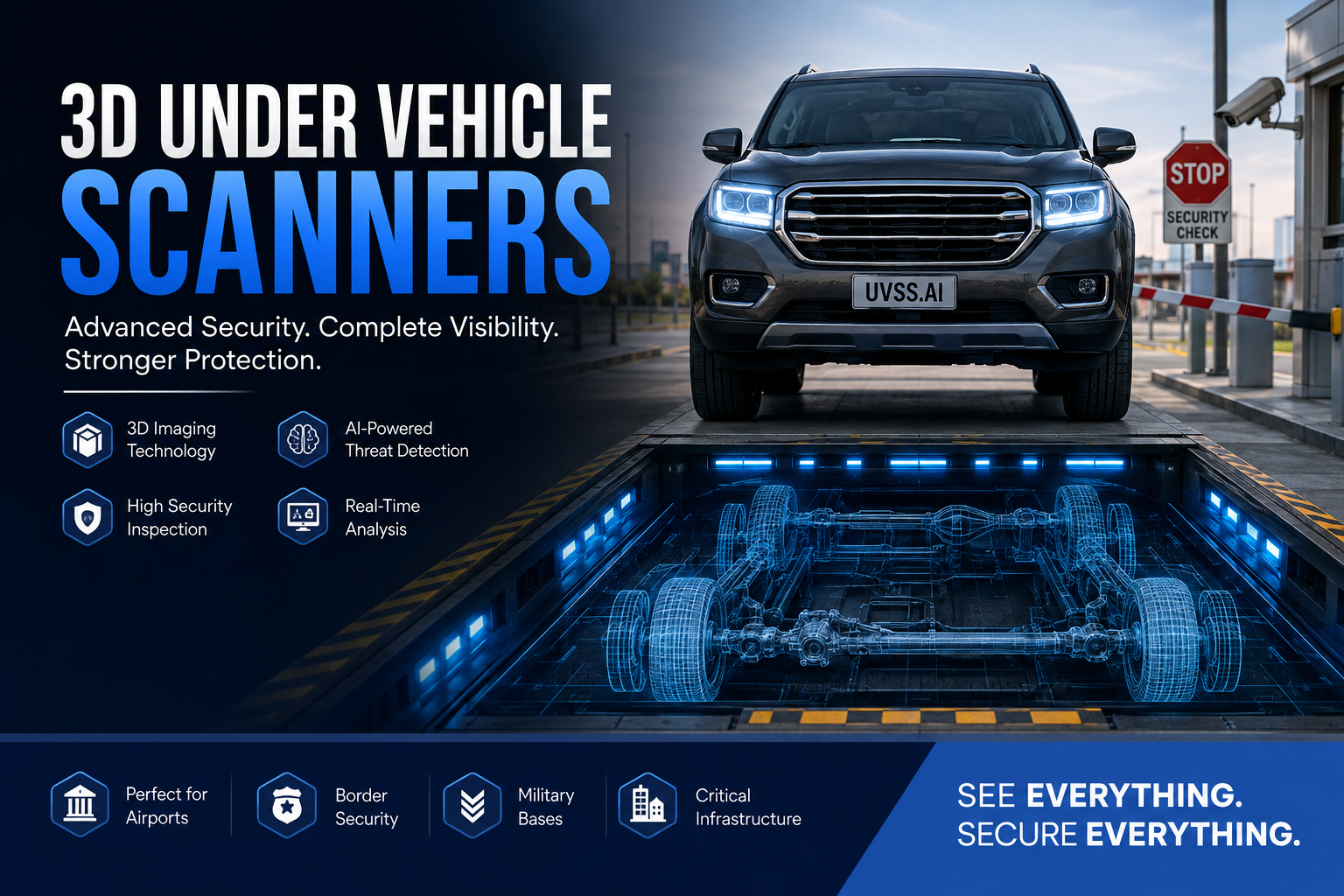
- 3D Under Vehicle Scanning Systems: Utilizing stereoscopic vision, structured light, or LiDAR point-cloud generation, 3D systems capture depth (
z-axis) data to construct interactive volumetric models of the chassis.
When evaluating a 3d under vehicle scanner vs traditional uvss setup for high-traffic environments, procurement teams must balance hardware cost against the technical demands of their security baseline.
┌───────────────────────────────────────────────────────────┐
│            UNDERBODY SCANNING EVOLUTION                   │
├───────────────────────────────────────────────────────────┤
│  1. Manual Mirrors  ──► Flat view, high human error       │
│  2. Traditional UVSS ──► High-res 2D image, flat view     │
│  3. 3D UVSS          ──► Volumetric depth, LiDAR/3D model │
└───────────────────────────────────────────────────────────┘
Technical Comparison: 3D Under Vehicle Scanner vs Traditional UVSS
Understanding the architectural differences between these platforms helps clarify why high-risk facilities are upgrading their checkpoint capabilities.
1. Depth Perception (Z-Axis Analysis)
A traditional 2D line-scan system captures flat X and Y pixel data, stitching horizontal visual slices into a high-definition photograph. While visual clarity is high, a flat image cannot differentiate between a dark shadow and a dark, magnetically attached package.
In contrast, the technical core of a 3d under vehicle scanner vs traditional uvss comparison centers on depth perception. A 3D scanner uses stereoscopic vision or LiDAR to build a dense point cloud, measuring the exact distance from the camera to every mechanical point under the vehicle. This enables operators to rotate the chassis model on-screen and inspect around fuel tanks, axles, and frame rails.
2. AI Anomaly Detection & Reduced False Alarms
Artificial Intelligence (AI) and Foreign Object Detection (FOD) algorithms perform significantly better on 3D data. When assessing a 3d under vehicle scanner vs traditional uvss, traditional 2D AI analytics frequently trigger false alarms caused by mud, water droplets, or minor dirt variations on the chassis.
Because a 3D system measures volumetric changes rather than just surface color, its software ignores surface grime and alerts guards only when an actual physical object alters the vehicle’s structural baseline.
Deploying an Under Vehicle Scanner for Critical Infrastructure
High-risk facilities—including nuclear power plants, oil and gas refineries, military bases, and international transport hubs—operate under zero-fail security standards. Relying on an under vehicle scanner for critical infrastructure ensures that threat screening keeps pace with high vehicle throughput without compromising thoroughness.
High-security environments require:
- High Throughput Speeds: Scanners must process heavy commercial trucks and passenger cars at speeds up to 30–40 km/h without image blurring.
- All-Weather Reliability: Equipment embedded in asphalt must carry an IP68 ingress protection rating to withstand heavy rain, sub-zero winter frost, mud, and heavy axle loads exceeding 40 tonnes.
- Integrated Multi-Layer Security: The system should link automatically with Automatic Number Plate Recognition (ANPR), driver-facing facial recognition cameras, and automated rising bollards.
Using a high-performance under vehicle scanner for critical infrastructure transforms a busy gate from a security bottleneck into a streamlined, automated checkpoint.
Comparison Matrix: 3D Under Vehicle Scanner vs Traditional UVSS
When assessing a 3d under vehicle scanner vs traditional uvss side-by-side, facilities teams can compare key operational metrics:
| Metric / Parameter | Traditional 2D UVSS | 3D Under Vehicle Scanner |
| Imaging Dimensionality | 2D Flat Composite (X/Y) | 3D Volumetric Point-Cloud (X/Y/Z) |
| Detection of Hidden Voids | Limited by camera angle & shadows | Complete 360° rotational view |
| False Alarm Rate | Moderate (sensitive to dirt/lighting) | Extremely Low (measures physical volume) |
| Scanning Speed Capabilities | Up to 30 km/h | Up to 30–40 km/h |
| ANPR & Database Integration | Full Support | Full Support |
| Ideal Operational Environment | Commercial office parks, logistics hubs | Military sites, nuclear plants, borders |
Operational Use Cases: Selecting the Right Technology
Selecting between a 3d under vehicle scanner vs traditional uvss depends on your facility’s operational profile and risk posture:
Commercial Real Estate & Fleet Hubs
For corporate office parks or suburban distribution warehouses, a high-resolution traditional 2D line-scan system often provides an optimal balance of performance and budget. It delivers fast throughput, clear digital records, and seamless integration with access barriers.
Defense, Energy, and Government Facilities
When evaluating a 3d under vehicle scanner vs traditional uvss for nuclear facilities, government embassies, or international border crossings, the 3D system is the preferred choice. The ability to identify volumetric modifications and concealed IEDs in complex undercarriages makes 3D scanning an essential investment for high-risk sites.
Why Partner with UVSS as Your Technology Reseller?
As a specialist reseller, UVSS provides objective guidance across leading scanner manufacturers rather than pushing a single hardware brand.
When you partner with UVSS, our engineering team supports your project lifecycle through:
- Comprehensive Site Assessments: Evaluating road civil design, power access, and lane traffic patterns.
- System Architecture & Integration: Linking undercarriage scanners natively into your existing Video Management Software (VMS), ANPR feeds, and physical barrier controllers.
- Lifecycle Maintenance & Training: Providing ongoing technical service, software upgrades, and guard team operational training to maintain optimal performance.
Conclusion: Upgrading Your Perimeter Security
As physical threats grow more sophisticated, leaving the underside of arriving vehicles unmonitored introduces unnecessary operational risk. Analyzing a 3d under vehicle scanner vs traditional uvss reveals that while traditional 2D systems remain effective for low-to-medium risk sites, 3D volumetric technology represents the future of threat detection for sensitive facilities.
Investing in a dedicated under vehicle scanner for critical infrastructure protects personnel, automates compliance logging, and eliminates perimeter blind spots.
Ready to secure your checkpoints? Contact the technical team at UVSS today to request a custom quote, compare scanning technologies, or schedule a live system demonstration.