Beyond 2D: How UVSS 3D Area Scan Helps with More Visibility and Better Protection
The threat landscape surrounding critical infrastructure, corporate campuses, and high-profile checkpoints is constantly shifting. For years, security directors have relied on traditional under-vehicle surveillance to monitor entry points. However, as concealment methods become more sophisticated, the limitations of standard imaging are becoming a glaring vulnerability. To truly harden a perimeter, facilities must look beyond flat, two-dimensional images and embrace volumetric scanning. Understanding exactly how UVSS 3D area scan helps with more visibility and better protection is fast becoming a core operational requirement for security integrators and facility managers alike.
At UVSS, as an industry-leading reseller of elite perimeter technology, we specialize in high-performance checkpoint security. We know that a traditional under vehicle scanning systems layout can leave dangerous blind spots. In this deep dive, we will analyze the technical mechanics behind stereoscopic data capture, compare it to older scanning frameworks, and demonstrate why a 3D architecture is the ultimate tool for proactive threat mitigation.
The Blind Spots of Legacy Under Vehicle Scanning Systems
To appreciate the value of a volumetric upgrade, it is necessary to examine the constraints of traditional linear technology. Standard under vehicle scanning systems typically utilize line-scan cameras. As a vehicle drives over the sensor array, the camera captures flat digital “slices” of the chassis and stitches them together into a long 2D image.
While this provides a basic visual record, it introduces significant operational challenges:
- Perspective and Shadow Distortion: A flat camera lens looking straight up cannot see “around” mechanical obstructions. Deep recesses, heat shields, and areas above the exhaust pipe remain shrouded in shadow.
- Speed Dependency: Line-scan cameras require a highly consistent driving speed to prevent the final image from looking stretched or squished. If a driver accelerates or taps the brakes over the scanner, the image becomes distorted, rendering automatic comparison features ineffective.
- Manual Fatigue: Because 2D images lack depth data, security guards must manually inspect the screen, hunting for anomalies among a chaotic landscape of pipes and wires. In high-traffic zones, this manual reliance inevitably leads to oversight.
How UVSS 3D Area Scan Helps with More Visibility and Better Protection
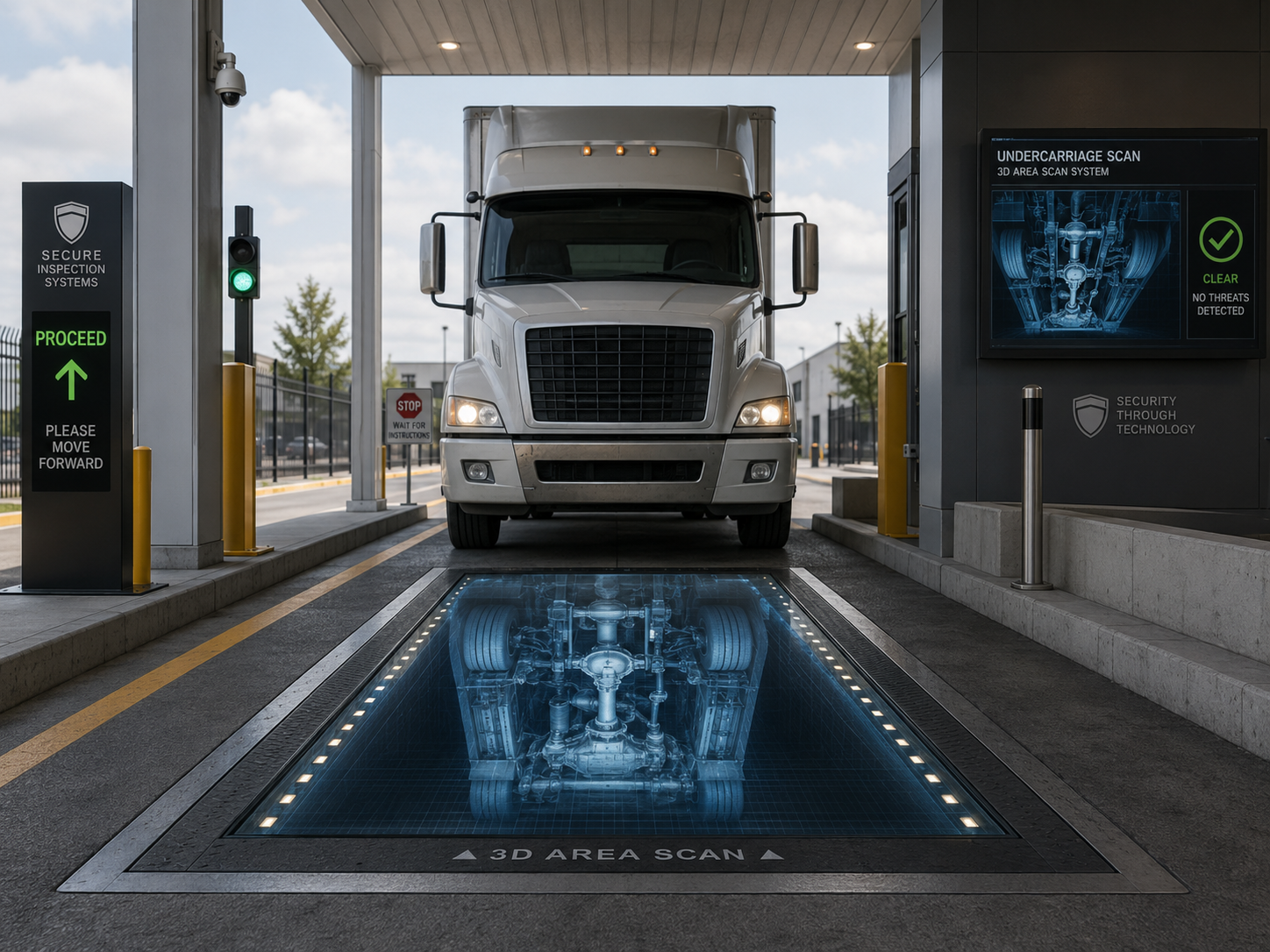
The transition to a 3D area scan framework redefines the checkpoint paradigm. Instead of taking a flat photograph, an advanced area-scan sensor captures multi-angle, overlapping stereoscopic viewpoints simultaneously. This spatial data is compiled in real-time to generate a true, high-resolution 3D digital twin of the vehicle’s undercarriage.
Let’s break down precisely how UVSS 3D area scan helps with more visibility and better protection:
1. Complete Structural Depth Perception
Chassis architectures are complex, three-dimensional terrains filled with alcoves and hidden compartments. The primary way how UVSS 3D area scan helps with more visibility and better protection is through true depth processing. By capturing stereoscopic angles, the system maps the exact elevation, depth, and volume of every component. If an object is tucked horizontally behind a frame rail, the multi-angled area sensors capture it, completely eliminating the shadows that cripple 2D systems.
2. Speed-Agnostic Imaging Accuracy
Because area scanning captures full frames rather than thin lines, it does not rely on a perfectly steady vehicle velocity. Whether a vehicle drives over the checkpoint at a crawl, accelerates rapidly, or comes to a complete stop directly over the array, the volumetric layout remains completely undistorted. This speed-agnostic capability is a massive reason how UVSS 3D area scan helps with more visibility and better protection in high-throughput environments like border crossings, toll plazas, and logistics hubs.
3. Automated AI Change Detection
When you look at how UVSS 3D area scan helps with more visibility and better protection from a software perspective, the integration of Artificial Intelligence is the true game-changer. Rather than forcing a guard to guess if a component belongs to a car, the 3D software automatically fingerprints the vehicle’s unique volumetric profile. When that vehicle returns, the system compares the live 3D model against its historical baseline. If a foreign object—like a magnetic tracking device, a hidden compartment, or a contraband package—has been attached, the AI instantly flags the precise coordinate in red.
Key Applications for High-Risk Perimeters
Implementing advanced under vehicle scanning systems equipped with 3D area-scan tech is critical across several key commercial and civil sectors:
- Data Centers & Corporate Hubs: Guarding against corporate espionage and physical tampering requires strict access control. A 3D area scan ensures that no tracking devices or unauthorized modifications enter the property.
- Government & Diplomatic Facilities: For embassies and parliament buildings, the threat of vehicle-borne improvised explosive devices (VBIEDs) is an evergreen concern. Knowing how UVSS 3D area scan helps with more visibility and better protection gives security forces the ability to detect tightly concealed packages instantly.
- Logistics & Border Security: Preventing smuggling and human trafficking requires an exhaustive check of heavy commercial trucks. 3D area sensors pierce through the complex underbellies of large trailers far more effectively than manual mirrors or flat scanners.
Integrating the Smart Checkpoint
A standalone scanner is only one piece of the puzzle. At UVSS, we advocate for an interoperable security architecture. By pairing a 3D area-scan unit with Automatic Number Plate Recognition (ANPR) and driver-facing cameras, facility managers build a comprehensive, 360-degree digital audit trail.
The moment a vehicle passes over the checkpoint, its license plate, driver identity, and 3D underbody model are linked together under a single timestamped entry. This unified ecosystem maximizes forensic accuracy and streamlines the workflow for security operators in a remote command center.
Why Partner with UVSS for Your Security Upgrade?
As a premier reseller of enterprise-grade security platforms, UVSS is committed to delivering more than just a box of hardware. We partner with your technical teams to evaluate your specific driveway constraints, traffic volumes, and local environmental factors.
We understand the granular mechanics of how UVSS 3D area scan helps with more visibility and better protection, and we help you maximize the return on your investment. From selecting rugged, all-weather, IP68-rated flush mounts to configuring the central AI threat-detection alerts, our team ensures your checkpoint operates flawlessly from day one.
Conclusion: Future-Proofing Your Facility Entry
The methods used by bad actors are becoming increasingly sophisticated, meaning traditional, flat-image surveillance is no longer a viable defense strategy. Moving to a volumetric framework is the most definitive way to secure your facility’s blind spots.
Investing in a platform after seeing how UVSS 3D area scan helps with more visibility and better protection ensures that your security personnel have the data they need to act quickly and decisively. By automating the threat detection process and eliminating speed-related image distortion, you dramatically lower operational risk.
Don’t leave the underbelly of your perimeter exposed. Contact the expert team at UVSS today for a technical consultation, and let us help you upgrade your under vehicle scanning systems to the gold standard of 3D protection.